The Nutrition Tracker Log Book: Your Physical Blueprint
Imagine trying to build a house without a blueprint, or navigate a new city without a map. That’s what managing your health can feel like when you’re operating on guesswork and memory. A Nutrition Tracker Log Book serves as that essential blueprint for your body. It’s more than just a notebook; it’s a structured, dedicated space to record not only what you eat, but the patterns, feelings, and outcomes tied to your nutrition. In a digital age saturated with fleeting app notifications, this physical log offers a tangible, focused method for accountability and insight.
The value of this tool isn’t confined to a single goal like weight loss. It’s a versatile companion for anyone seeking clarity. You might be a busy professional noticing mid-afternoon energy crashes, a parent trying to model balanced eating for your family, an athlete fine-tuning performance, or someone managing a specific health condition like diabetes or food sensitivities. The Nutrition Tracker Log Book becomes your personal research journal. By consistently logging meals, hydration, sleep, and even mood, you move from subjective feeling—“I feel sluggish”—to objective data—“On days with less than 60g of protein and late meals, my energy drops by 3 PM.”
Mapping Your Day with Pen and Paper
The act of writing in a Nutrition Tracker Log Book creates a mindfulness that typing often misses. It forces a moment of pause. Consider a typical scenario: you’re rushing through lunch at your desk. An app might let you quickly tap “sandwich,” but the log book asks you to write down “whole wheat turkey sandwich, with avocado and spinach, ate in 10 minutes while checking emails.” That extra detail is the gold. You start to see connections between your eating environment and your satisfaction. Maybe you realize that hurried meals leave you feeling unsatisfied, leading to unnecessary snacking later. The log transforms from a simple food diary into a holistic habit tracker.
For creators, entrepreneurs, and freelancers whose work demands mental stamina, this log can be a productivity tool. Cognitive function is deeply linked to nutrition. By tracking, you might discover that a high-sugar breakfast leads to a foggy creative block by midday, while a balanced one with protein keeps you focused. The log provides evidence to tailor your diet to support your work, making it a practical business asset for anyone whose mind is their primary tool.
Real-World Applications Beyond the Kitchen
The use cases extend far beyond the individual. A nutrition coach or educator might use such a log book as a structured framework for clients, providing a clear, shared document for review sessions. A blogger focused on health and wellness could use their own tracked data to create deeply authentic, evidence-based content, moving beyond generic advice to sharing personal, documented journeys. In a family setting, a shared log (or individual ones for older children) can demystify nutrition, turning it into an observable, educational activity rather than a set of rules.
Another powerful application is in managing dietary interventions. For someone exploring gluten sensitivity, a detailed Nutrition Tracker Log Book that includes notes on physical symptoms alongside food entries becomes a diagnostic aid. You can look back over weeks to spot correlations that would be impossible to recall. This turns you into an active participant in your healthcare, equipped with data to discuss with a doctor or nutritionist.
Choosing a Tool Built for the Job
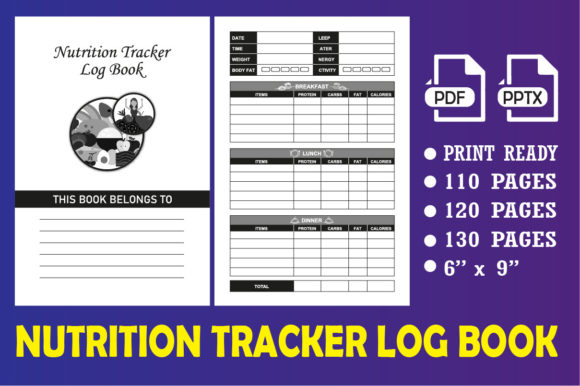
When you decide to use a Nutrition Tracker Log Book, the quality and design of the tool itself matters significantly. A haphazard notebook with blank pages often leads to inconsistent, disorganized entries that are hard to analyze. A purpose-built log, with formatted sections for time, food, portions, water intake, and notes, guides your recording and ensures your data is structured and comparable over time. This is where a professionally designed interior, like the one described, proves its worth.
Features like a clean 6” x 9” size make it portable—it can sit on your kitchen counter, go in your work bag, or travel with you. Having multiple page count options (110, 120, 130) lets you choose a duration that matches your commitment, whether it’s a 90-day challenge or a year-long lifestyle change. The fact that it’s fully formatted and tested for publishing means every page is functional; no space is wasted, and the layout is intuitive from day one. This readiness eliminates the friction of setting up your own system, which is a common hurdle that causes people to abandon tracking.
From Data to Sustainable Change
The ultimate goal of any tracker is to inform action. After a few weeks with a Nutrition Tracker Log Book, patterns emerge. You might see that your fiber intake is consistently low, or that social dinners lead to portions double your usual size. This isn’t about judgment; it’s about awareness. With awareness, you can make specific, small adjustments. Instead of a vague resolution to “eat healthier,” you have a targeted plan: “add a vegetable to lunch every day” or “prepare a snack before going to a party.”
This process also highlights non-food factors. Your log might show that poor sleep nights correlate with higher sugar cravings the next day. This shifts your focus from just food to sleep hygiene, illustrating how nutrition is interconnected with your entire lifestyle. The log book becomes the central document that ties these threads together, giving you a comprehensive view of your well-being.
Considering Your Commitment
Before starting with a Nutrition Tracker Log Book, think honestly about your rhythm. Tracking is most valuable when it’s consistent, but it doesn’t have to be perfect. Some people thrive logging every meal in detail. Others might start with just logging breakfast and dinner, or focusing on one specific metric like water intake. The key is to use the tool in a way that feels sustainable for you. A high-quality, easy-to-use log book reduces the effort, making consistency more likely.
Also, consider your purpose. Are you troubleshooting a specific issue? Supporting a new fitness regimen? Or simply building general awareness? Your goal will dictate what you pay attention to in the log. The flexibility of a well-designed book allows you to adapt it to your focus. The included PDF and PPTX files mean you can also preview and understand the layout completely before you begin, ensuring it matches your needs.
In essence, a Nutrition Tracker Log Book is a catalyst for informed self-management. It moves nutrition from the realm of theory and sporadic effort into a documented, personal experiment. Whether you’re an entrepreneur optimizing your energy, a hobbyist athlete tracking performance, or simply an individual wanting to feel more in control of your health, this tool provides the structured space to make that happen. By choosing a layout designed for clarity and ease, you set yourself up not just to track, but to truly understand and, ultimately, to thrive.