The Essential Role of a Woodworking Log Book in the Craft
Woodworking, at its heart, is a process of transformation. It begins with raw timber and ends with a finished piece, whether a simple box or a complex heirloom cabinet. Between these points lies a journey of decisions, measurements, adjustments, and learning. For many woodworkers, this journey is documented not just in the final object, but within a specialized tool: the woodworking log book. This dedicated journal serves as the central repository for a project's life cycle, capturing the practical details and personal insights that are invaluable for both immediate success and long-term growth.
Unlike a simple notebook, a well-designed wood working log book is structured to anticipate the needs of the craft. It provides consistent, organized spaces to record information that would otherwise be scattered across sketches, sticky notes, or memory. The act of logging becomes part of the workflow, a pause for reflection and planning that often leads to greater precision and fewer errors.
Core Characteristics of a Professional Woodworking Log
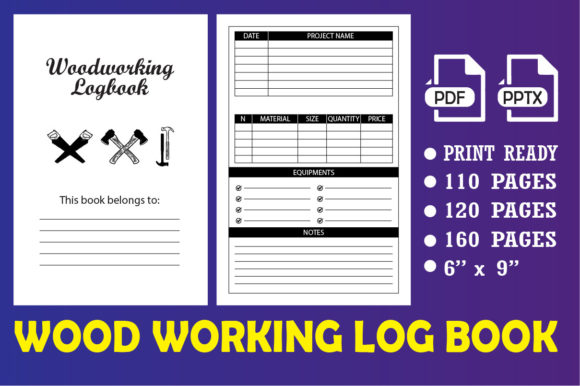
A functional log book for woodworking is defined by several key characteristics. First, it prioritizes utility over ornamentation. Its layout should be clear and intuitive, guiding the user to fill in pertinent data without confusion. Common sections include project identification, material lists, cut lists, tool and machine settings, procedural steps, adjustments made during construction, and final finishing notes.
Second, it encourages consistency. Using the same log for every project allows a woodworker to develop a personal standard for documentation. This makes it easier to review past work, compare techniques, and replicate successes. Third, it serves as a permanent record. Paper logs are tangible and durable, surviving beyond digital files that may become lost or inaccessible. They become a physical archive of one's craft evolution.
The Practical Advantages of Systematic Documentation
The advantages of maintaining a detailed wood working log are numerous and touch upon every aspect of the craft. From a quality control perspective, it reduces mistakes. Writing down a cut list with exact dimensions before approaching the saw minimizes material waste and ensures parts fit together correctly. Recording the specific router bit used and the depth setting for a particular joint allows for perfect duplication if the technique is needed again.
For learning and skill development, the log is indispensable. After completing a project, a woodworker can review the log to analyze what worked and what didn’t. Perhaps a certain glue type proved insufficient, or a clamping method introduced slight warping. These observations become lessons embedded in the log, ready to inform future decisions. It transforms experience into documented knowledge.
From a purely practical standpoint, a log book aids in project management and cost tracking. Listing all purchased materials with their costs provides a clear view of project expenditure. Noting the time spent on each phase—design, rough cutting, joinery, sanding, finishing—helps in estimating future projects more accurately, which is crucial for hobbyists considering selling their work or professionals running a business.
Application Across Different User Groups
The utility of a woodworking journal extends across the broad spectrum of individuals engaged in the craft, each finding value tailored to their needs.
Hobbyists and Home Craftsmen often use a log book to deepen their enjoyment and improve results. It provides structure to a leisure activity, helping them progress from one project to the next with increasing confidence. The log becomes a personal history of their hobby, filled with sketches and notes that are as rewarding to revisit as the finished pieces themselves.
Professional Woodworkers and Small Studio Owners rely on documentation for efficiency and reproducibility. In a professional context, consistency and repeatability are key to client satisfaction and business viability. A log allows a professional to precisely recreate a piece for a client or to refine a design over multiple iterations. It also functions as an important record for troubleshooting and for training apprentices or assistants.
Educators and Instructors in woodworking programs find log books to be excellent teaching tools. They can assign students to maintain logs for their class projects, emphasizing the importance of planning, measurement, and self-assessment. The log book teaches discipline and scientific method alongside manual skills.
Designers and Prototype Developers, even those not exclusively focused on wood, use such logs when working with timber. The iterative process of design—building, evaluating, modifying—requires meticulous recording of each iteration's parameters. A specialized log provides the framework for this development cycle.
Integrating the Log into the Woodworking Workflow
The most effective log book is one that is seamlessly integrated into the natural workflow of a project. This integration typically follows a phased approach.
The first phase is Planning and Design. Here, the log book’s initial pages are used to capture the project concept, initial sketches, and inspiration sources. The material list is compiled, including species, dimensions, and source of the wood. A detailed cut list is calculated and written down, which is the foundational step for precise execution.
The second phase is Execution and Construction. During the build, the log is kept readily accessible in the workshop. As each step is performed—cross-cutting, joinery work, assembly—relevant details are noted. These might include specific blade types, fence settings, sandpaper grit sequences, or unexpected observations about the material's behavior. This real-time documentation is crucial for maintaining control over a complex process.
The final phase is Finishing and Reflection. The choices for finishes—stain, oil, varnish—along with their application methods and results are recorded. After the project is complete, a summary section can be used to note overall lessons, project duration, total cost, and final thoughts. This closes the loop, making the log a complete project case study.
Considerations for Selecting or Creating a Log Book
Given the importance of this tool, the physical design of the wood working log book itself warrants consideration. Many woodworkers start with generic notebooks but soon realize the benefit of a pre-formatted interior designed specifically for the craft. A dedicated KDP (Kindle Direct Publishing) interior template, for instance, can offer a ready-made structure.
Key features to look for include appropriate dimensions, such as 6" x 9", which is a portable yet spacious size. The page count—options like 110, 120, or 160 pages—should align with the volume of projects one anticipates documenting. High-resolution, clean formatting ensures the pages are legible and professional, whether used digitally or printed. The inclusion of both PDF and editable PPTX files in a product package allows for flexibility; the PDF is ready for immediate printing and use, while the PPTX enables customization for those who wish to tailor sections to their exact workflow before printing.
Ultimately, whether one purchases a pre-formatted interior or designs their own, the goal is the same: to create a reliable, systematic companion for the woodworking process. The very act of committing details to paper slows the mind, focuses attention, and builds a legacy of accumulated craft knowledge that stands alongside the tangible creations in the workshop.
The Long-Term Value of a Woodworking Archive
Beyond the immediate project, a collection of completed log books forms an archive of immense personal or professional value. This archive allows for meta-analysis of one's work. A woodworker can look back over years of logs to identify trends: perhaps a gradual shift towards using more hand tools, or an increased preference for a particular wood species. For a business, this archive is a knowledge asset, protecting against the loss of critical process information if key personnel change.
In an age where digital tools are pervasive, the analog, tactile nature of a paper wood working log holds a particular resonance for a hands-on craft. It requires no software updates, batteries, or login credentials. It is always available, resistant to accidental deletion, and possesses the unique character of handwritten notes and sketches. It becomes not just a record, but an artifact of the craft itself, a testament to the thoughtful, measured, and creative process of working with wood.